The Product Feature Mix

When you are building a new product, you probably can’t afford to develop all the features you can think of.

And that’s a good thing — it forces you to think about which features it makes sense to build first. Dumping big money in the development of a new product without having an idea what categories of features you count on for success, can lead to monumental flops like Meta’s Multiverse.

Organising product features in meaningful categories allows you to prioritise the features with most impact on the strategic objectives stemming from your opportunity type.

Our Feature Mix model describes products in a way understandable for the whole team, directing and synchronising group efforts towards a shared vision. Practice shows that this dramatically increases the team’s chance to output a successful product.

Each product can have it’s own feature categorisation, but we have synthesised the most common, impactful, and universally applicable feature categories we encountered in our extended practice and research.

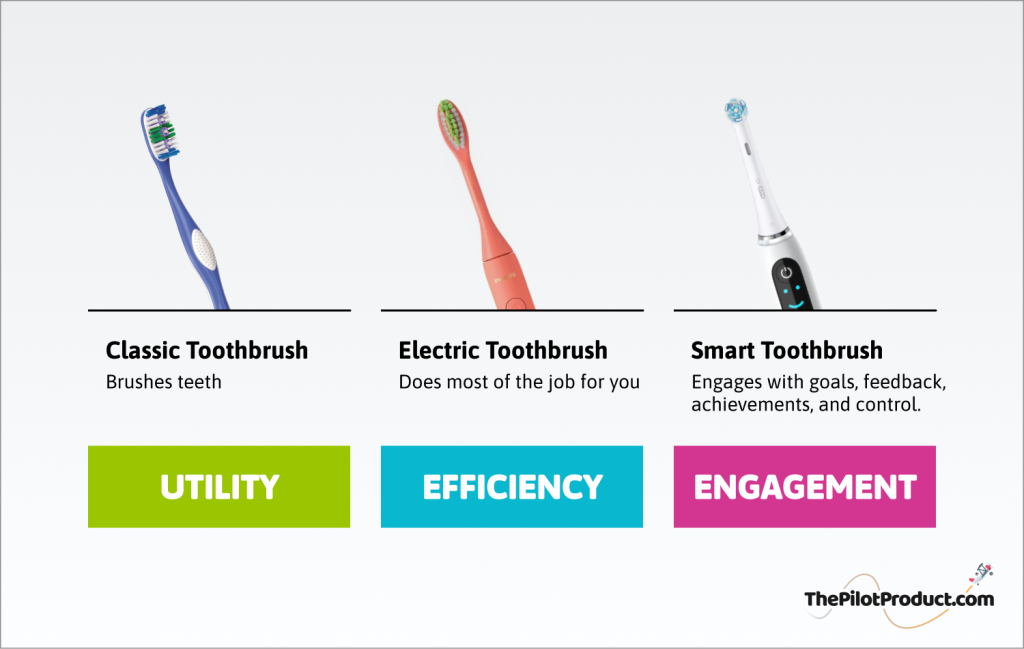
To make our model easy to understand and remember, we are going to use a product everyone knows and hopefully uses regularly — the toothbrush.

Feature Category 1: Utility

Utility is WHAT the product does. It usually defines the product’s category.

utility

: reliable and consistent performance of useful and measurable environmental transformation

From the perspective of utility, products are objective transformers — they transform objects into something more useful:

  • a toothbrush transforms toothpaste and dirty teeth into clean teeth useful for a confident shiny smile
  • financial software transforms a mess of unrelated numbers into an organized set of related numbers useful for statutory or management accounting, and financial planning
  • compression algorithms transform large sets of data into smaller sets of data more useful for streaming or limited storage

Utility features are essential in the context of Opportunity type 1: Solve because an utility feature enables you to do something that you wouldn’t be able to do without the feature, i.e. it allows you to solve a problem you otherwise couldn’t. Most people would buy and use a classic toothbrush in situations where they have forgotten to take their own on a trip and they have no other means to solve the urgent problem.

Feature category 2: Efficiency

Efficiency is about HOW the product does what it does. It’s the first level of added value.

efficiency

: the ratio of the total useful transformation to the total resource cost expended by the user


From the perspective of efficiency, you can improve how the product performs by:

  • making it cheaper (more accessible)
  • making it easier to use (efficiency of use)
  • reducing tasks or completing tasks faster
  • increasing the value of the output (the usefulness of the transformation)
 

Efficiency features are essential in the context of Opportunity type 2: Improve because they allow you to solve the problem in a more efficient, improved way. The problem is known and solved; classic toothbrushes exist, but electric toothbrushes improve the solution by employing electricity to do most of the work for the user.

It is worth noting that there are products which increase the efficiency of the utility of other products. For example, Google Maps increases the efficiency of whatever transportation utility is being used – the brain spends less resources following clear navigation instructions instead of trying to figure out the way on its own.

In addition, a feature may be an utility feature in one product and efficiency feature in another. For example, AI background removal is an utility feature for a smartphone user, but an efficiency feature in Photoshop – where the problem could solved with the old and less efficient utility feature of color range selection.

Feature Category 3: Engagement

Engagement answers the question WHY would anyone use a product beyond utility and efficiency. The answer usually is — it’s fun to use.

engagement

: when the use of a product results in a transformation of the user’s emotional state creating intrinsic drive for subsequent use.

Utility is about the external, objective transformation of the environment; Engagement is about the internal, subjective transformation of the user.

Utility can easily be measured, but Engagement needs to be felt first. Especially in the context of building a Pilot Product when there are no tons of users generating tons of interaction data. In a later stage, when there is a statistically significant sample, engagement can be measured, too.

Products focused on Engagement are most effective in the context of Opportunity type 3: Discover. Interviews, brainstorming and research (orthodox methods for problem discovery) often produce conclusions with little connection to objective market realities. 

We have seen countless times how users state they will use some feature, but in reality they don’t. Or find a feature irrelevant on paper, but when implemented they use it a lot. A kind of a “faster horses” effect.

On the other hand, when users actively use an engaging pilot product, there’s a high chance that they will start to “hack” it, i.e. use it in unintended, unexpected ways which is always an indication for what the market really needs. 

Through the actual use you can be sure that you’ve discovered something.

Related Posts